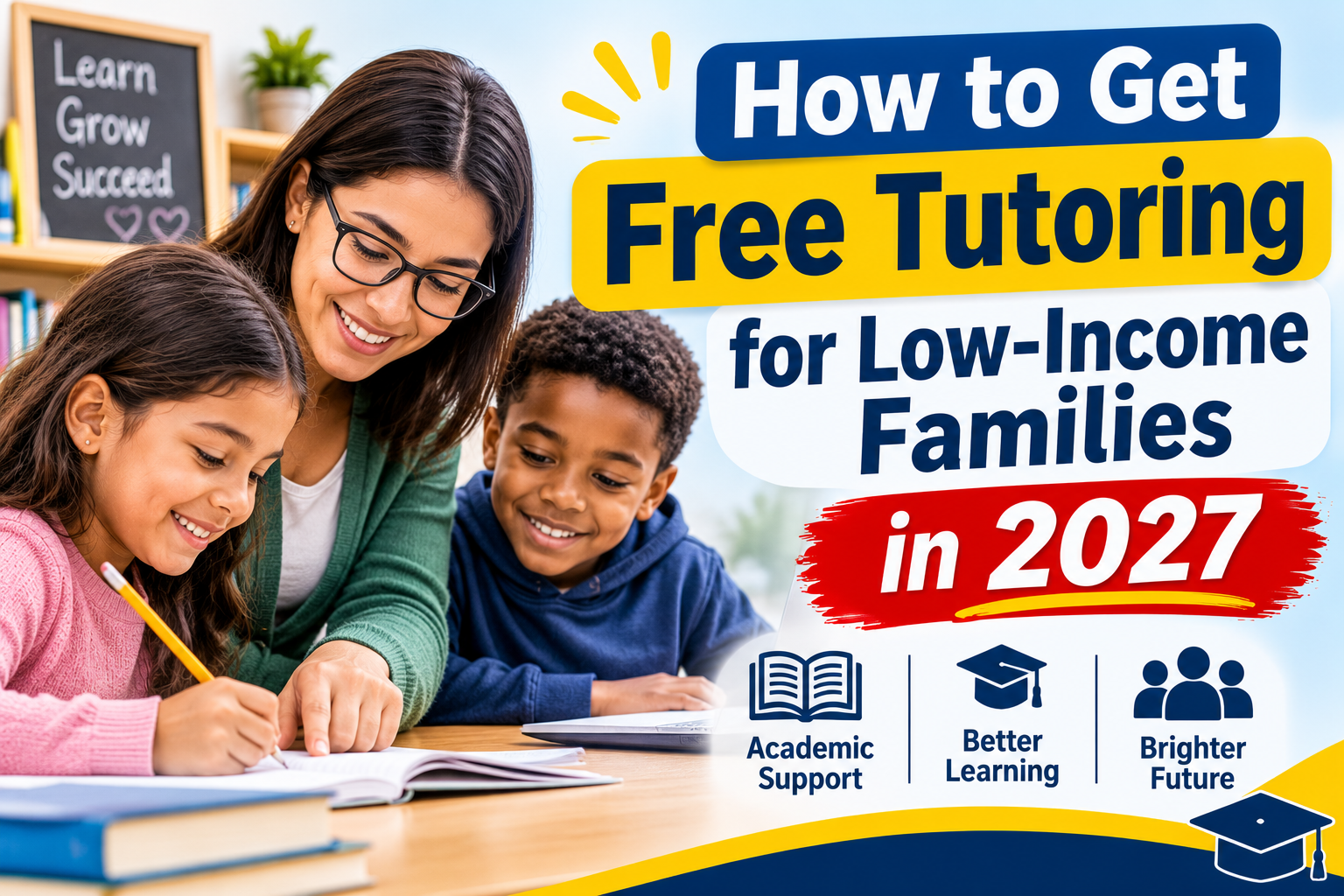
Do you want to know how to get Free Tutoring for Low Income Families Within Minutes? If yes, you’re on the right page.
Children from low income families may face educational challenges because their parents cannot always afford private tutoring, additional learning materials, or other academic support. When a student falls behind in school, getting extra help can make a meaningful difference in their confidence, learning progress, and academic performance.
Fortunately, families in the United States have several ways to find free or affordable tutoring. Public schools, nonprofit organizations, libraries, community centers, and online tutoring platforms offer different types of academic support for eligible students.
Some programs provide free one on one tutoring, while others offer homework assistance, mentoring, after school learning activities, or access to educational technology.
In this guide, we explain how to get free tutoring for low income families in 2027, including online resources, nonprofit organizations, school based services, government supported programs, and practical steps parents can take to find academic help for their children.
What Is Free Tutoring for Low Income Families?
Free tutoring for low income families refers to academic assistance provided to students without requiring their families to pay the usual private tutoring fees.
These services may be offered by schools, nonprofit organizations, government supported education programs, public libraries, colleges, and community organizations.
The purpose is to help students who need additional academic support but may not have the financial resources to hire a private tutor.
Depending on the program, students may receive help with:
- Mathematics and algebra.
- Reading and writing.
- English language skills.
- Science and social studies.
- Homework and school assignments.
- Test preparation.
- Study habits and time management.
- College preparation and academic planning.
Some programs focus specifically on students from low income households, while others are available to students through their school, library, military family affiliation, or community membership.
It is important to understand that not every free tutoring service has the same eligibility requirements. Some may ask about household income, participation in a school meal program, or enrollment at a Title I school. Others may provide free tutoring to all students who have access through a participating school or library.
What Is Tutoring?
Tutoring is additional academic instruction that helps students understand subjects, improve their skills, and work through topics they find difficult.
A tutor may be a certified teacher, professional educator, college student, trained volunteer, or another qualified individual.
Unlike a regular classroom, tutoring often focuses on the individual student’s learning needs. A tutor can identify knowledge gaps, explain difficult concepts, provide practice exercises, and help students develop better study habits.
Tutoring can take place in several settings, including:
- A student’s school.
- A public library.
- A community center.
- A nonprofit organization.
- A private tutoring center.
- An online learning platform.
- A student’s home, when an appropriate service is available.
The best tutoring arrangement depends on the student’s age, learning needs, subject, schedule, and access to technology.
How Does Tutoring Help Students?
Additional academic support can help children develop the skills and confidence needed to succeed in school.
Here are some important benefits of tutoring.
1. Personalized Learning
Students do not all learn at the same speed. A tutor can focus on the specific topics a child finds difficult instead of following the same pace as an entire classroom.
2. Improved Academic Performance
Regular practice and explanations can help students understand challenging subjects, complete assignments, and prepare for examinations.
3. Better Learning Confidence
Children who struggle with schoolwork may become discouraged. Supportive tutoring can help them recognize their progress and feel more confident about learning.
4. Stronger Study Habits
Tutors can help students organize assignments, manage their time, prepare for tests, and develop effective learning routines.
5. Access to Additional Educational Resources
Some tutoring programs also provide learning materials, online exercises, educational technology, and mentoring.
6. Support Beyond the Classroom
Tutoring can give students an opportunity to ask questions they may not feel comfortable asking during regular classroom lessons.
Tutoring is not only for students who are failing. Children who are already performing well can also benefit from additional instruction, advanced learning activities, and test preparation.
Does Your Child Need Tutoring?
Every child has different learning needs. Some students understand classroom lessons easily, while others need more time, practice, or individual attention.
Parents may want to consider tutoring if they notice any of the following signs:
- Grades have declined over several assignments or grading periods.
- A child regularly struggles with mathematics, reading, or writing.
- Homework takes much longer than expected.
- The student has difficulty understanding classroom instructions.
- A child feels anxious or frustrated about schoolwork.
- Assignments are frequently incomplete or submitted late.
- The student lacks confidence when answering academic questions.
- A teacher has expressed concerns about learning progress.
These signs do not necessarily mean that a child needs a private tutor. Sometimes, the student may need additional classroom support, help with organization, a different teaching approach, or an evaluation for a learning difficulty.
Parents should consider speaking with the child’s teacher or school counselor before choosing a tutoring program. The school may already provide academic assistance at no cost.
Types of Free Tutoring for Low Income Families
Free tutoring programs use different teaching methods. Understanding these options can help parents choose a suitable arrangement.
1. One to One Tutoring
One to one tutoring involves a single tutor working with one student.
This format allows the tutor to focus on the child’s individual learning needs, explain difficult topics, and adjust lessons according to the student’s progress.
It can be especially helpful for children who need additional attention in a particular subject.
Some nonprofit organizations, including Learn To Be, offer free individual tutoring to eligible students.
2. Small Group Tutoring
Small group tutoring generally involves one tutor working with a few students at the same time.
Students can ask questions, practice together, and learn from one another.
This format may be less individualized than one to one instruction, but it can provide useful academic support in a collaborative environment.
3. Group and Learning Center Tutoring
Some schools, libraries, community centers, and nonprofit organizations organize tutoring sessions for larger groups of students.
These sessions may focus on homework completion, reading practice, mathematics, or general academic improvement.
Group tutoring can be a useful option for families who cannot access individual tutoring.
4. In Person Tutoring
In person tutoring takes place at a physical location, such as a school, library, community center, or tutoring organization.
Students can interact directly with tutors, complete practice activities, and receive help in a supervised learning environment.
5. Online Tutoring
Online tutoring allows students to connect with tutors through a computer, tablet, or smartphone.
Depending on the service, students may receive live lessons, one to one academic support, homework assistance, and access to learning materials.
Online tutoring can be especially useful for families who live far from tutoring centers or have transportation difficulties.
However, students generally need a suitable device and reliable internet connection.
How to Find Free Tutoring for Low Income Families
Parents can explore several local and online resources before paying for private tutoring.
1. Contact Your Child’s School
Your child’s school should be one of the first places to ask about free academic support.
Teachers, counselors, and school administrators may know about tutoring services, after school programs, academic intervention, or community partnerships.
Ask the school:
- Does it provide free tutoring after school?
- Are there reading or mathematics intervention programs?
- Does the district partner with nonprofit tutoring organizations?
- Are summer learning programs available?
- Can students receive additional academic support during the school day?
Some schools receive federal Title I funding to support students in schools serving communities with higher levels of poverty. The school or district can explain which academic services are available and whether your child qualifies.
2. Contact Your Local Public Library
Public libraries are valuable educational resources for families.
Depending on the library, students may have access to:
- Free homework assistance.
- Online tutoring platforms.
- Reading programs.
- Educational workshops.
- Computer and internet access.
- Study rooms.
- Learning materials and digital resources.
Some libraries provide access to Tutor.com through a library card.
Contact your local library or visit its website to check whether free tutoring is available.
3. Explore Nonprofit Organizations
Several nonprofit organizations provide free tutoring or academic assistance to eligible students.
Some focus on low income households, while others serve children through local clubs, mentoring programs, or online platforms.
Examples include Learn To Be, UPchieve, and Boys & Girls Clubs of America.
4. Ask Community and Religious Organizations
Local community groups, churches, and other nonprofit organizations may operate after school learning programs or connect families with volunteer tutors.
Availability depends on the community.
Ask whether the organization provides supervised homework help, reading support, mathematics tutoring, or referrals to other educational services.
5. Ask Teachers and College Students About Volunteer Tutoring
Some colleges and universities have student volunteer programs, education departments, and community outreach initiatives.
College students studying education, mathematics, science, or English may participate in tutoring or mentoring programs.
Parents can contact nearby colleges, university outreach offices, or community organizations to ask whether they offer student tutoring services.
Before arranging private or informal tutoring for a child, check the tutor’s qualifications and make sure the learning environment is safe and appropriate.
Government Supported Tutoring and Education Programs
The federal government supports several education initiatives that can provide academic assistance to eligible students.
However, not all federal education grants are paid directly to families. Some fund schools, colleges, and educational organizations that then provide services to students.
1. Title I School Based Support
Title I, Part A is a federal education program that provides funding to eligible schools and districts serving communities with higher concentrations of students from low income households.
Schools can use Title I funds for approved educational services intended to help students meet academic standards.
Depending on the school’s program, students may receive:
- Additional instruction in reading and mathematics.
- Academic intervention.
- Supplemental learning materials.
- Family engagement activities.
- Extended learning opportunities.
- School based support services.
Parents should contact their school or district to learn which Title I services are available.
Important: Title I does not automatically give every low income family a separate tutoring grant or voucher. Services are organized through participating schools and districts.
2. Upward Bound Program
Upward Bound is part of the federal TRIO programs administered by the U.S. Department of Education.
It is designed to help eligible high school students prepare for college and other postsecondary education opportunities.
Participating projects can provide academic tutoring, college preparation, assistance with admissions applications, academic counseling, and other support.
The program primarily serves students who meet specific eligibility criteria, including certain income and first generation college student requirements, with additional eligibility pathways.
It is not a general tutoring service for all elementary or middle school students.
Students and parents can contact a participating Upward Bound project at a nearby college or university to ask about enrollment.
Official information: https://www.ed.gov/grants-and-programs/grants-higher-education/federal-trio-programs/upward-bound-program
3. Student Support Services Program
Student Support Services is another federal TRIO program.
It provides academic support to eligible students who are already enrolled in college.
Depending on the participating institution, services may include:
- Tutoring.
- Academic advising.
- Study skills assistance.
- Financial aid guidance.
- Counseling and mentoring.
- Help with college retention and graduation.
This program is intended for eligible college students rather than families seeking general K-12 tutoring.
Students should contact their college’s Student Support Services office to determine whether the institution operates a program and what eligibility requirements apply.
Official information: https://www.ed.gov/grants-and-programs/grants-higher-education/federal-trio-programs/student-support-services-program
4. State and Local Education Programs
State education departments and local school districts may offer additional academic support through publicly funded programs.
Examples include:
- After school learning programs.
- Summer learning opportunities.
- Reading intervention.
- Mathematics support.
- English language learning.
- Special education services.
- Community based academic partnerships.
Program names, eligibility requirements, and funding vary by state and school district.
Parents can visit their state’s Department of Education website or contact their local school district to find available services.
5. Casey’s Cash for Classrooms Grant Program
Casey’s Cash for Classrooms is a corporate education grant program that supports eligible K-12 public and nonprofit private schools in Casey’s operating areas.
The program can help schools fund physical improvements, educational materials, teacher support, and community engagement projects.
It is important to understand that this is a grant for eligible schools, not a direct tutoring payment for individual families.
For the 2027 grant cycle, Casey’s announced applications for eligible schools in its 19 state operating area, with awards of up to $50,000. The announced application deadline was November 13, 2026, so families and schools should check the official website for the next application cycle.
Official information: https://www.caseys.com/community
Organizations That Offer Free Tutoring for Low Income Families
Several nonprofit organizations and educational platforms can help families find free tutoring.
Eligibility, subject availability, grade levels, and application procedures differ, so check the official website before enrolling.
1. Learn To Be
Website: https://www.learntobe.org/
Learn To Be is a nonprofit organization that connects students with volunteer tutors for online academic support.
The organization provides tutoring in K-12 subjects and aims to make additional educational assistance accessible to underserved students.
Students may receive individual tutoring in subjects such as:
- Mathematics.
- Reading.
- Writing.
- Science.
- English.
- Other school subjects, depending on tutor availability.
Learn To Be confirms that its tutoring is completely free. Families may make an optional contribution, but payment is not required and does not affect the tutoring they receive.
Parents can visit its website to learn about the student application process and available tutoring.
2. UPchieve
Website: https://upchieve.org/
UPchieve is a nonprofit online tutoring platform that provides free academic support to eligible middle and high school students in the United States.
Students can connect with volunteer tutors for help with subjects such as mathematics, science, reading, and writing.
Its eligibility requirements generally focus on students attending eligible schools or living in qualifying low income ZIP codes.
UPchieve currently supports middle and high school students, not elementary school or college students.
Students can check their eligibility through the official sign up page:
If a student believes they qualify but receives an ineligible result, the organization provides a request-access process.
3. Boys & Girls Clubs of America
Website: https://www.bgca.org/
Boys & Girls Clubs of America operates local clubs that provide educational, recreational, and youth development programs.
One of its academic programs is Power Hour: Making Minutes Count.
Power Hour helps club members ages 6–18 complete homework, receive academic support, and develop independent learning habits.
Activities may include:
- Homework assistance.
- Reading and writing practice.
- Academic skill development.
- Educational activities.
- Support from youth development professionals and volunteers.
Program availability and membership fees vary by local club. Families should contact their nearest location to ask about financial assistance, scholarships, and free or reduced cost membership.
4. Pandemic Professors
Website: https://www.pandemicprofessors.org/
Pandemic Professors is an organization that connects students with volunteer tutors for online academic assistance.
Its services have included individualized tutoring and mentoring for students who need additional educational support.
However, the organization currently states that it is not accepting student applications.
Families can check its website for future enrollment announcements rather than assuming that tutoring is immediately available.
5. Tutor.com
Website: https://www.tutor.com/
Tutor.com provides online academic assistance through partnerships with schools, colleges, public libraries, employers, and military organizations.
Students may be able to access free tutoring if their school, library, or another participating organization provides access.
Eligible military connected families may also receive no cost tutoring through the Tutor.com for U.S. Military Families program.
Subjects and services vary depending on the access arrangement.
To find out whether your child can use Tutor.com without paying:
- Ask the school whether it provides Tutor.com access.
- Check your public library’s online resources.
- Review military family eligibility if applicable.
- Contact the participating organization for login instructions.
Official access information: https://www.tutor.com/get-access
6. Schoolhouse.world
Website: https://schoolhouse.world/
Schoolhouse.world is an online learning platform that offers peer led tutoring and learning sessions.
Students can participate in small group academic sessions and learn from other students who have knowledge of particular subjects.
It can be an additional resource for students who want to practice academic concepts and receive help in a collaborative learning environment.
Check the platform for current subjects, session availability, and participation requirements.
7. Local YMCA Programs
Website: https://www.ymca.org/
Some YMCA branches provide after school programs, youth development activities, and academic support.
Services vary by location, and not every branch offers formal tutoring.
Contact your local YMCA to ask whether it has homework assistance, educational enrichment, or programs for children from low income households.
Ask about membership discounts, scholarships, and financial assistance if fees apply.
Tutoring Resources Through Public Libraries
Public libraries deserve special attention because they can provide educational support without requiring families to pay for private tutoring.
Many libraries offer free access to computers, digital learning resources, homework assistance, and study spaces.
Some also partner with online tutoring services.
How to Find Free Library Tutoring
Follow these steps:
- Search online for your local public library.
- Visit its official website.
- Look for sections labeled Children’s Services, Teen Services, Homework Help, or Online Learning.
- Check whether the library provides access to Tutor.com or another tutoring platform.
- Ask whether a library card is required.
- Contact the library to confirm current availability and age requirements.
Some services are available remotely, while others require students to visit the library.
If your family does not have reliable internet access at home, ask whether the library offers free computer access or Wi-Fi.
How to Apply for Free Tutoring
The application process depends on the organization providing the service.
However, parents can follow these general steps to find and enroll their children in a suitable program.
Step 1: Identify Your Child’s Learning Needs
Start by identifying the subjects or skills where your child needs additional help.
For example, a student may need support with:
- Basic mathematics.
- Reading comprehension.
- Essay writing.
- Science assignments.
- Homework organization.
- Test preparation.
Speaking with your child’s teacher can help identify the areas that need attention.
Step 2: Search for Suitable Programs
Look for tutoring services through schools, libraries, nonprofit organizations, and online platforms.
Compare the programs based on grade level, subjects, location, schedule, and eligibility.
Step 3: Check Eligibility Requirements
Some programs require students to meet income based criteria or attend an eligible school.
Others may be available through a library card, military affiliation, school partnership, or community membership.
Review the requirements before submitting an application.
Step 4: Prepare the Required Information
Depending on the organization, you may be asked to provide:
- Student’s name and grade.
- Parent or guardian contact information.
- School information.
- Subjects requiring assistance.
- Household income information, if required.
- Proof of eligibility for a specific program, if applicable.
Do not send sensitive documents unless the organization has explained why they are necessary and you have verified that the application website is legitimate.
Step 5: Complete the Application
Submit the application using the organization’s official website or the process provided by the school or library.
Review the information carefully and save any confirmation details.
Step 6: Schedule Tutoring Sessions
After acceptance, follow the organization’s instructions to schedule tutoring.
Discuss the student’s learning goals, preferred schedule, and any specific challenges with the tutor.
Step 7: Monitor Progress
Parents should check whether the tutoring is helping their child.
Ask about progress, review completed assignments, and communicate with the tutor or school when additional support is needed.
Educational Challenges Faced by Low Income Families
Students from financially struggling households may face several barriers that affect their education.
1. Economic Barriers
Private tutoring, learning materials, educational software, and test preparation can be expensive.
Families managing rent, food, transportation, utilities, and other essential expenses may not have enough money for additional academic services.
Free tutoring programs can reduce some of these costs and make educational support more accessible.
2. Limited Access to Technology
Online tutoring can be difficult for families without a reliable computer, tablet, or internet connection.
Students may also have to share devices with siblings or parents.
Public libraries, school computer labs, and community centers can help provide access to technology.
3. Limited Educational Resources
Some students have fewer books, learning materials, quiet study spaces, and educational opportunities outside school.
Libraries and community learning programs can help address these gaps.
4. Limited Time for Parental Support
Parents may work multiple jobs or have demanding schedules, making it difficult to supervise homework every day.
Tutoring programs can provide additional academic guidance and a structured learning environment.
5. Transportation Difficulties
Families without reliable transportation may struggle to reach tutoring centers or after school programs.
Online tutoring and services offered at nearby schools or libraries can provide alternatives.
Tips for Choosing the Right Free Tutoring Program
Not every tutoring service is suitable for every student. Before enrolling, consider the following factors.
1. Check the Grade Level Requirements
Some platforms support only middle and high school students, while others provide K-12 tutoring.
2. Review Subject Availability
Make sure the program offers help in the subjects your child needs.
3. Understand the Schedule
Check whether tutoring is available after school, on weekends, or during school holidays.
4. Confirm Whether It Is Completely Free
Some services are free through schools or libraries but charge families who sign up independently.
Ask about membership fees, donations, equipment costs, and any other possible charges.
5. Review Tutor Qualifications
Ask how tutors are selected, whether they receive training, and whether the organization has appropriate child safety procedures.
6. Consider Online Access
If the program is online, make sure your child has a suitable device and internet connection.
7. Monitor Your Child’s Progress
Look for improvements in understanding, confidence, homework completion, and classroom performance.
The goal should be meaningful learning progress rather than simply completing more tutoring sessions.
Frequently Asked Questions About Free Tutoring for Low Income Families
Can I Get Free Online Tutoring for My Child?
Yes. Several organizations provide free online tutoring to eligible students.
Learn To Be offers free tutoring for K-12 students, while UPchieve serves eligible middle and high school students in the United States.
Tutor.com may also be available at no cost through participating schools, libraries, employers, and military programs.
What Are the Qualifications for a Private Tutor to Receive Grants?
Private tutors do not automatically qualify for education grants.
Some grant programs support teachers, schools, colleges, and nonprofit organizations rather than individual private tutors.
Eligibility depends on the specific funding opportunity. Applicants may need to demonstrate professional qualifications, organizational status, project goals, financial need, or community impact.
For example, the NEA Foundation’s Learning & Leadership Grants support eligible educators who are current National Education Association members and seek professional development funding.
These grants are not general payments for private tutors who want to provide free lessons.
How Can I Get Free Tutoring for Low Income Families?
Start by contacting your child’s school and local public library.
You can also explore nonprofit tutoring platforms such as Learn To Be and UPchieve, local Boys & Girls Clubs, and community organizations.
Check each program’s eligibility requirements and application instructions.
How Much Money Can a Family Receive as a Tutoring Grant?
There is no standard federal tutoring grant amount that every family can receive.
Most tutoring programs provide academic services directly rather than giving families cash.
Some education grants are awarded to schools, nonprofit organizations, or educators to support educational projects. The amount depends on the funding opportunity and its rules.
Is Learn To Be Tutoring Completely Free?
Yes. Learn To Be states that its tutoring is completely free.
Families may make an optional contribution if they wish, but donations do not affect the tutoring services students receive.
Is UPchieve Free for All Students?
UPchieve is free for eligible middle and high school students in the United States.
Eligibility is generally based on attending an eligible school or living in an eligible low income ZIP code.
Elementary school students and college students are not currently supported through its standard student tutoring service.
Does Tutor.com Cost Money?
Tutor.com offers free access through participating schools, colleges, public libraries, employers, and eligible military programs.
Students without access through one of these partnerships may need to purchase a paid plan.
Check the official website for current pricing and access options.
Can My Child Receive Free Tutoring at a Public Library?
Possibly. Some public libraries provide homework help, tutoring, online learning resources, and access to Tutor.com.
Services differ by library, so contact your local branch to check availability.
Are There Free Tutoring Programs for Elementary School Students?
Yes. Families can explore Learn To Be, local school programs, library homework assistance, and Boys & Girls Clubs.
UPchieve currently focuses on middle and high school students, so it is not the right option for elementary students.
Can College Students Get Free Tutoring?
Yes. Eligible college students may receive tutoring through their institution, Student Support Services, campus learning centers, and participating online tutoring partnerships.
Contact the college’s academic support office to find available services.
Is Free Tutoring Available During Summer?
Some schools, libraries, nonprofits, and community organizations offer summer learning programs.
Availability varies by location and funding. Ask your school district about summer academic support before the school year ends.
Conclusion
Free tutoring can help children from low income families receive the additional academic support they need without placing more financial pressure on their parents.
Schools, public libraries, nonprofit organizations, community centers, and online tutoring platforms offer different ways to access educational assistance.
Families can start by contacting their child’s school and local library, then explore programs such as Learn To Be, UPchieve, Boys & Girls Clubs of America, and Tutor.com.
The most important step is to find a program that matches the child’s grade level, learning needs, and schedule. With consistent academic support, students can strengthen their skills, improve their confidence, and make meaningful progress in school.