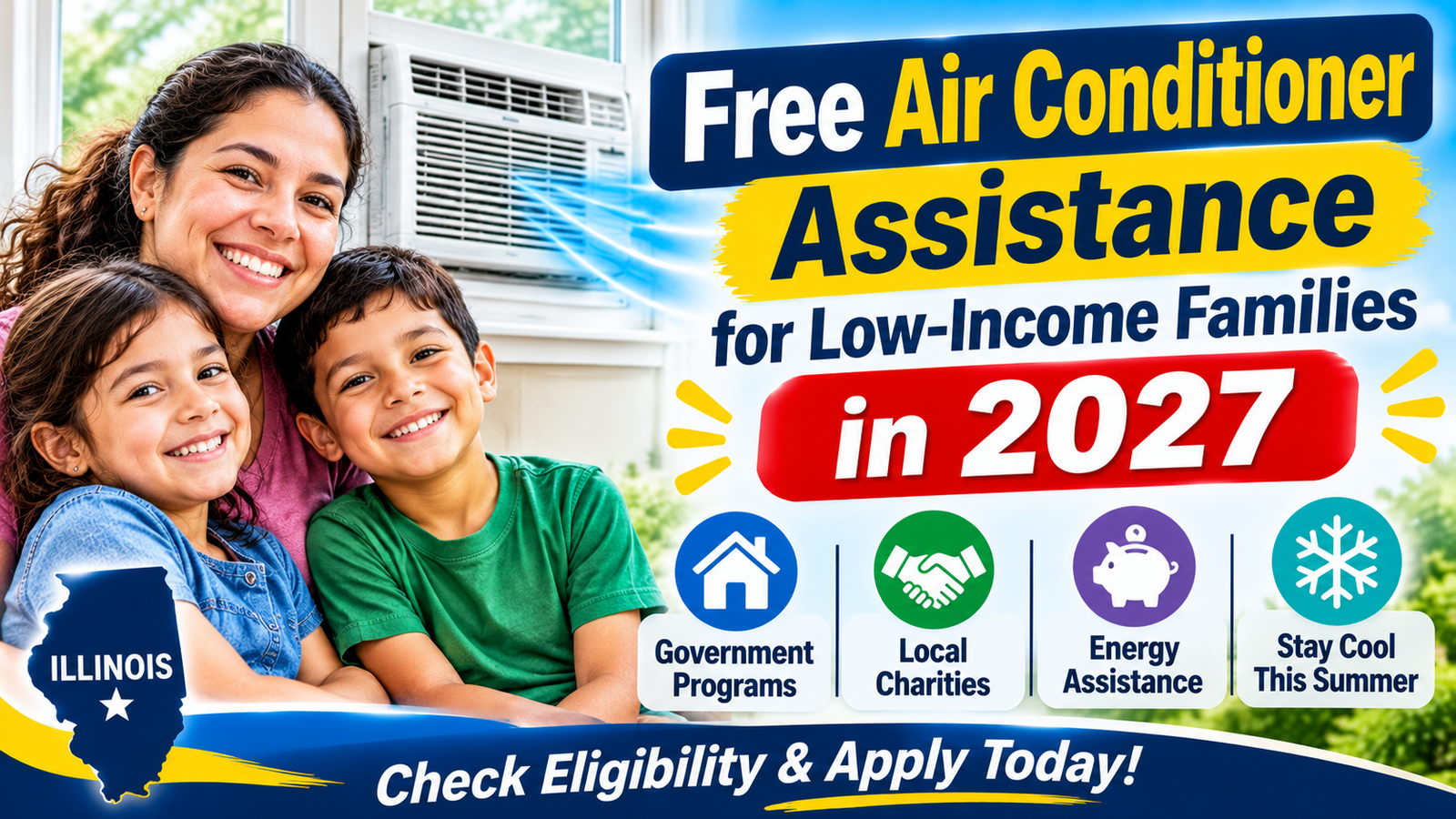
Air conditioning can be essential during extreme summer temperatures, especially for seniors, young children, people with disabilities, and individuals with medical conditions that become worse in hot weather. However, purchasing an air conditioner and paying higher electricity bills can be difficult for low income households.
Fortunately, some government programs, utility companies, nonprofit organizations, and local charities offer cooling assistance. Depending on where you live, you may qualify for a free air conditioner, help repairing an existing cooling system, financial assistance for electricity bills, or home weatherization services.
The most important program to investigate is the Low Income Home Energy Assistance Program (LIHEAP). Some states use LIHEAP funding to provide cooling assistance, including purchasing or repairing air conditioners. Other states use the funding only for utility bills or emergency energy assistance.
There is no single nationwide program that guarantees a free air conditioner to every low income household. Eligibility, funding, application dates, and available benefits depend on your state and local service provider.
This guide explains how to find free air conditioner assistance in 2027, which programs to contact, what documents you may need, and how to apply. If you are a Illinois residence the you can get Illinois Window Replacement Program.
How to Get a Free Air Conditioner for Low Income Families
Low income households can investigate several programs that may help them obtain an air conditioner or reduce the cost of keeping their homes cool.
The best options include:
- LIHEAP cooling assistance through participating states.
- State Home Energy Assistance Programs (HEAP).
- The Department of Energy’s Weatherization Assistance Program.
- Utility company energy efficiency programs.
- Local churches and charitable organizations.
- Community Action Agencies.
- Emergency assistance for households with serious medical or heat related needs.
Some programs provide an air conditioner directly, while others pay a vendor, repair existing equipment, or help with electricity expenses.
Before applying, contact the local agency and ask whether it offers an actual cooling equipment benefit. Do not assume that regular LIHEAP assistance or weatherization automatically includes a free air conditioner.
1. Low Income Home Energy Assistance Program (LIHEAP)
The Low Income Home Energy Assistance Program (LIHEAP) is a federally funded program administered by the U.S. Department of Health and Human Services.
It helps eligible low income households manage their home energy expenses. Depending on the state, territory, or tribal program, assistance may include:
- Heating and cooling bill assistance.
- Emergency energy assistance.
- Help during energy related crises.
- Certain home energy repairs.
- Weatherization services.
- Cooling equipment assistance in participating areas.
LIHEAP is especially important for households that include older adults, people with disabilities, and young children.
According to the federal LIHEAP FY 2024 fact sheet, approximately 163,000 households received cooling assistance during that fiscal year. This demonstrates that cooling assistance is available through some LIHEAP programs, but it is not offered in the same way everywhere.
Does LIHEAP Provide Free Air Conditioners?
Some state and local LIHEAP programs may help eligible households purchase, repair, or install cooling equipment.
Depending on the location, assistance may include:
- A new window air conditioner.
- Repair of an existing air conditioner.
- A portable cooling unit.
- A fan when an air conditioner cannot be safely installed.
- Financial assistance for cooling expenses.
- Emergency cooling support.
However, regular LIHEAP assistance usually helps with energy bills. A household should specifically ask whether its state offers a cooling equipment benefit.
LIHEAP Eligibility Requirements
Each state establishes its own eligibility guidelines within federal program requirements.
Common factors include:
- Household income.
- Household size.
- Residency in the state or service area.
- Energy expenses.
- Participation in certain public assistance programs.
- Household members who are older adults, disabled, or young children.
- Medical conditions that may become worse in extreme heat.
Some states use income limits based on a percentage of the federal poverty guidelines, while others use state median income.
Receiving SSI, SNAP, or another qualifying benefit may help establish eligibility in some locations, but it does not automatically guarantee an air conditioner.
How to Apply for LIHEAP
- Visit the federal LIHEAP website.
- Find your state’s LIHEAP office.
- Contact the local agency that handles applications.
- Ask whether cooling equipment assistance is available.
- Check the current income limits and application dates.
- Submit the required documents.
- Follow up with the agency about your application.
You can also use USA.gov’s energy bill assistance guide to find your state’s application information.
2. State HEAP Cooling Assistance Programs
Some states operate Home Energy Assistance Programs that provide specific cooling benefits.
One important example is New York’s HEAP Cooling Assistance Benefit.
New York HEAP Cooling Assistance
New York’s Cooling Assistance Benefit helps eligible households purchase and install an air conditioner or fan.
For the 2026 cooling season, New York provided assistance of up to:
- $800, including installation, for a window or portable air conditioner or fan.
- $1,000, including installation, for an existing wall sleeve air conditioner.
If an air conditioner cannot be safely installed, an eligible household may receive a fan instead.
The program has additional eligibility conditions. Applicants may need to meet income requirements or participate in certain qualifying assistance programs. Their household must also include an eligible vulnerable person, such as:
- Someone aged 60 or older.
- A child under six.
- Someone with a documented medical condition that becomes worse in extreme heat.
Applicants generally must not have a working air conditioner or must have an existing unit that is at least five years old. Other restrictions apply, including a five year limit on receiving a HEAP funded air conditioner.
The 2026 cooling application period closed on June 5, 2026. Applicants should check the official state website for the next cooling season’s dates and requirements.
How to apply:
- Visit New York Cooling Assistance.
- Contact the local HEAP office.
- Call the New York HEAP information line at 1-800-342-3009.
New York’s program is an example, not a nationwide benefit. Other states have different cooling assistance rules, and some do not offer equipment benefits at all.
3. Weatherization Assistance Program (WAP)
The U.S. Department of Energy operates the Weatherization Assistance Program (WAP) to help eligible low income households improve their homes’ energy efficiency.
The program is administered through state agencies, local governments, nonprofit organizations, and Community Action Agencies.
Weatherization may help households reduce energy consumption, improve indoor comfort, and make cooling systems operate more efficiently.
Depending on the state’s approved measures and the home’s energy assessment, services may include:
- Repairing or replacing eligible cooling systems.
- Improving insulation.
- Sealing air leaks.
- Improving ventilation.
- Repairing or replacing certain windows and doors.
- Installing energy efficient equipment.
- Making certain health and safety improvements.
Can WAP Provide a Free Air Conditioner?
Potentially, but not every state includes air conditioner replacement or installation in its weatherization services.
The Department of Energy identifies repair or replacement of heating and cooling systems as possible weatherization measures. However, state plans determine which improvements can be funded, and the home’s energy assessment determines which work is appropriate.
Therefore, an applicant should not assume that qualifying for weatherization means receiving a new AC unit.
Who Qualifies for Weatherization Assistance?
Under DOE guidelines, households may qualify based on income or participation in certain assistance programs.
Common eligibility considerations include:
- Household income at or below 200% of the federal poverty guidelines.
- Eligibility through certain benefits, including SSI.
- State specific income rules.
- Household energy burden and other program priorities.
Priority may be given to households with:
- Older adults.
- People with disabilities.
- Young children.
- High energy expenses.
- Significant energy burdens.
Both homeowners and renters may apply. Renters generally need landlord permission before work begins.
How to Apply
- Visit the Department of Energy Weatherization Assistance Program.
- Find your state weatherization administrator.
- Locate the agency serving your county.
- Ask whether cooling system repair or replacement is included.
- Submit the application and income documents.
- Arrange a home energy assessment if selected.
4. Utility Company Cooling and Energy Assistance
Some electric and natural gas companies offer energy efficiency programs that help low income customers reduce energy consumption.
Depending on the provider and location, assistance may include:
- Free or discounted energy assessments.
- Air conditioner repair or replacement.
- Energy efficient cooling equipment.
- Smart thermostats.
- Insulation and air sealing.
- Electricity bill assistance.
- Special payment plans.
Some utilities work with state agencies or nonprofit organizations to deliver these services.
How to Find Utility Company Assistance
Contact the electric company that provides service to your home and ask:
- Does the company offer free or discounted air conditioners?
- Are there energy efficiency programs for low income households?
- Can I receive help repairing my existing AC?
- Are there medical or senior citizen cooling programs?
- Does the company provide summer electricity bill assistance?
You can also check the ENERGY STAR Low-Income Home Energy Upgrade Assistance resource for information about available home energy programs.
5. Help From Churches and Local Charities
Local churches and charitable organizations may help households that cannot afford essential appliances.
Depending on available donations and funding, assistance may include:
- Used or donated air conditioners.
- Fans.
- Emergency financial assistance.
- Help paying utility bills.
- Referrals to community assistance programs.
- Other household necessities.
However, churches do not have a nationwide free air conditioner program. Assistance is determined locally, and some organizations may not have cooling equipment available.
How to Ask a Church for Assistance
Contact churches in your community and explain your situation.
You can ask whether they:
- Have an emergency assistance fund.
- Accept donated air conditioners.
- Work with local charities to distribute cooling equipment.
- Help seniors or people with medical needs.
- Can refer you to another organization.
You do not generally need to attend a church or belong to a particular religion to ask whether charitable assistance is available. Each organization sets its own policies.
Be prepared to explain your household income, housing situation, and why an air conditioner is needed.
6. Society of St. Vincent de Paul
The Society of St. Vincent de Paul is a nonprofit charitable organization that helps people experiencing financial hardship.
Local conferences and councils provide different types of assistance depending on available volunteers, donations, and funding.
Some locations may help with:
- Emergency household expenses.
- Utility bills.
- Furniture and essential appliances.
- Food and other necessities.
- Referrals to local assistance programs.
A local chapter may occasionally have access to donated cooling equipment or emergency support during extreme heat.
However, there is no guarantee that every St. Vincent de Paul location provides free air conditioners.
How to Apply
- Find a local St. Vincent de Paul organization.
- Contact its assistance office or local conference.
- Explain your financial circumstances and cooling needs.
- Ask whether air conditioner donations or emergency cooling assistance are available.
- Follow the local application and referral process.
Visit the Society of St. Vincent de Paul to find local assistance.
7. Salvation Army Assistance
The Salvation Army provides emergency and community assistance through local service centers.
Depending on location and funding, services may include:
- Emergency financial support.
- Utility assistance.
- Household necessities.
- Seasonal relief.
- Referrals to other charitable organizations.
Some local Salvation Army offices may be able to help households find donated appliances or cooling assistance during hot weather.
However, the organization does not guarantee a free air conditioner nationwide.
How to Apply
Contact your nearest Salvation Army service center and ask whether it has:
- Air conditioner donation programs.
- Emergency cooling assistance.
- Household appliance assistance.
- Utility bill support.
- Referrals to local cooling programs.
Visit The Salvation Army to locate a nearby office.
8. Community Action Agencies
Community Action Agencies (CAAs) are local organizations that provide services to low income households.
They often administer LIHEAP, weatherization, and other community assistance programs.
A local agency may be able to help you find:
- Cooling assistance.
- Air conditioner repair programs.
- Energy bill assistance.
- Weatherization services.
- Emergency financial support.
- Donated household appliances.
Even if the agency does not provide air conditioners directly, it may know which local organizations have funding or equipment available.
How to Find a Community Action Agency
- Visit the Community Action Partnership.
- Search for an agency serving your county.
- Contact its assistance department.
- Ask specifically about cooling equipment assistance.
- Request information about current applications and eligibility requirements.
Community Action Agencies are often one of the best starting points because they may administer several assistance programs in the same area.
9. ENERGY STAR and Energy Efficient Cooling Options
ENERGY STAR is a program that identifies products meeting energy efficiency standards.
An ENERGY STAR certified air conditioner may use less electricity than a comparable non certified model, depending on the product and how it is used.
This can help households reduce electricity expenses during summer.
However, ENERGY STAR does not operate a nationwide free air conditioner giveaway program.
Are There Federal Tax Credits for Air Conditioners in 2027?
The old article mentioned a tax credit of 10% up to $500 for ENERGY STAR air conditioners.
That information should not be used as a 2027 benefit.
The federal Energy Efficient Home Improvement Credit under Section 25C was terminated for property placed in service after December 31, 2025. Therefore, homeowners should not assume they can claim that federal credit for a qualifying air conditioner installed in 2027.
Some state, local, or utility incentives may still be available. Check the rules before purchasing equipment.
For current federal tax information, visit the IRS Residential Energy Credits page.
Who Qualifies for Free Air Conditioner Assistance?
Eligibility varies by program and location. However, assistance is generally intended for households that have limited income or face additional health and safety risks during extreme temperatures.
Common eligibility factors include:
1. Household Income
Most government cooling assistance programs have income limits.
The limit may be based on:
- Federal poverty guidelines.
- State median income.
- Household size.
- Local program funding rules.
2. State Residency
Applicants generally must live in the state, county, or service area covered by the program.
3. Medical Conditions
Some cooling programs prioritize households with people whose health may be affected by extreme heat.
Examples include certain respiratory, cardiovascular, and other chronic medical conditions.
The program may require medical documentation.
4. Older Adults
Some programs give priority to households with members aged 60 or 65 and older.
5. Young Children
Households with infants and young children may receive priority under certain state or local cooling programs.
6. Disability Status
People with disabilities may qualify for priority assistance or special accommodations, depending on the program.
7. Existing Cooling Equipment
Some programs require that the household does not have a working air conditioner or has an older unit that meets the program’s replacement criteria.
Always check the exact rules before applying.
Documents You May Need
Preparing documents in advance can make the application process easier.
Depending on the program, you may need:
- Government issued photo identification.
- Proof of current address.
- Proof of household income.
- Recent pay stubs.
- Social Security or SSI benefit statements.
- SNAP or other public assistance documentation.
- Recent electricity bills.
- Household member information.
- Medical documentation when required.
- Landlord permission if you rent and installation requires it.
The agency will tell you exactly which documents are necessary.
Do not submit sensitive medical or financial records to an unofficial website or individual. Use the application process provided by the official agency.
How to Apply for Cooling Assistance
Follow these steps to find available assistance in your area.
Step 1: Identify Your Cooling Needs
Determine whether you need:
- A new air conditioner.
- Repair of an existing unit.
- A portable cooling unit.
- A fan.
- Help paying electricity bills.
- Emergency cooling support.
Knowing what you need will help the agency identify the right program.
Step 2: Contact Your State LIHEAP Office
Start with your state’s LIHEAP office.
Ask whether the state provides cooling assistance and whether that assistance includes equipment purchases or repairs.
You can find state information through the LIHEAP website.
Step 3: Contact Your Local Community Action Agency
Your local Community Action Agency may administer LIHEAP, weatherization, and other financial assistance programs.
Ask whether applications are open and whether cooling equipment is available.
Step 4: Check Your Weatherization Program
Contact your state weatherization administrator and ask whether eligible homes can receive cooling system repairs or replacement.
Step 5: Contact Your Utility Company
Ask about low income energy efficiency programs, cooling equipment incentives, and summer bill assistance.
Step 6: Contact Local Charities
Reach out to churches, the Salvation Army, and St. Vincent de Paul.
Explain your circumstances and ask whether they have donated appliances or emergency assistance.
Step 7: Submit the Application
Complete the official application and provide the requested documents.
Do not pay anyone who promises guaranteed government approval or a free air conditioner.
Step 8: Follow Up
Ask for an application confirmation number and the expected processing time.
Keep your phone number, email address, and mailing address updated so the agency can contact you.
What to Do If You Cannot Get a Free Air Conditioner
Not every household will qualify for cooling equipment assistance. Some programs have limited funding, and others may not provide air conditioners at all.
If you cannot receive a free unit, consider these alternatives:
- Ask about a donated fan or portable cooling device.
- Contact a local charity for emergency assistance.
- Ask your utility provider about payment plans.
- Visit a public cooling center during extreme heat.
- Contact 211 for local emergency resources.
- Ask your doctor or local health department about heat related safety resources.
- Explore energy efficient equipment rebates that may be available locally.
Find a Cooling Center
During extreme heat, many cities and counties open cooling centers in public buildings such as libraries, community centers, and other designated facilities.
Call 211 or contact your local health department to ask about nearby cooling centers.
If someone develops signs of heat stroke, including confusion, loss of consciousness, or a very high body temperature, seek emergency medical help immediately.
Frequently Asked Questions
1. Can I get a free air conditioner from the government?
Possibly. Some states use LIHEAP funding or other assistance programs to provide air conditioners, repair existing cooling equipment, or offer fans. Availability depends on your state and local program.
2. Does LIHEAP provide free air conditioners?
Some LIHEAP funded state programs provide cooling equipment assistance. However, regular LIHEAP benefits usually help with energy bills. Contact your state office to confirm whether it offers air conditioner purchases or repairs.
3. Can seniors get free air conditioners?
Some state and local programs prioritize older adults, particularly those with limited income or medical conditions affected by extreme heat. Contact your LIHEAP office and local Community Action Agency.
4. Can people receiving SSI get cooling assistance?
Possibly. Some programs use SSI participation as an eligibility pathway or give priority to households with disabled members. However, SSI does not automatically guarantee a free air conditioner.
5. Does the Weatherization Assistance Program provide free AC units?
The Department of Energy’s Weatherization Assistance Program can fund certain heating and cooling system repairs or replacements when included in the state’s approved measures and supported by the home’s assessment. It does not guarantee a new air conditioner to every eligible household.
6. Can churches give away free air conditioners?
Some churches may provide donated appliances or emergency financial assistance. However, these programs are local and depend on donations and available funding.
7. Does the Salvation Army provide free air conditioners?
Some local Salvation Army offices may help with household necessities or refer applicants to cooling assistance programs. Free air conditioner availability is not guaranteed nationwide.
8. Can I receive an air conditioner if I rent my home?
Possibly. Some cooling programs allow renters to apply. However, the program may require landlord permission for installation, especially when the work involves permanent changes to the property.
9. Are free air purifiers included in cooling assistance?
Not usually. Air purifiers and air conditioners serve different purposes. Some emergency or disaster related programs may distribute air purifiers, but they are not automatically included in ordinary cooling assistance.
10. Where can I find free air conditioner assistance near me?
Start with your state LIHEAP office, local Community Action Agency, utility provider, and 211. These organizations can help identify cooling equipment assistance and other local resources.
Conclusion
Low income households may have several ways to obtain help with air conditioning in 2027. LIHEAP cooling assistance, state HEAP programs, weatherization services, utility company incentives, and local charities are important resources to investigate.
However, free air conditioner assistance is not available everywhere. Some programs provide equipment, while others help with repairs, utility bills, or home energy improvements.
The best first step is to contact your state LIHEAP office and local Community Action Agency. Ask specifically whether they offer free air conditioners, cooling equipment repairs, or emergency cooling assistance.
If you are a senior, have a disability, or live with someone whose medical condition becomes worse in extreme heat, explain that when contacting the agency. These circumstances may affect eligibility or priority under certain local programs.
Always verify current program rules, funding, and application deadlines through official government agencies or recognized local organizations before sharing personal information or paying for assistance.